
Apple's Difficult Calculus
Apple could own SME agents outright.
Not compete for the market. Own it, the way IBM owned business computing for a decade after 1981. The hardware exists. The silicon is already designed. The distribution is already built. Every accountant, every law firm, every architecture practice in the developed world already knows where the Apple Store is.
All it would take is an infinite supply of 256GB Mac Studios.
Preinstall DeepSeek V4 Flash 0731 and the serving stack. Turn it on, point your staff at it, done. It just works - for all the agents you need to get your work done. Apple has run that campaign before, and it has never had better material.
They could do it.
But right now what's making money for Apple is iPhones.
The arithmetic
Every Mac Studio eats the memory of sixteen iPhones.
The iPhone 18 Pro will carry 16GB - if Apple can afford the RAM. The upper end of the range is going there, because on-device inference demands it. A 256GB Mac Studio is sixteen of those, and Apple is buying from the same constrained pool for both.
By the margins: an iPhone 18 Pro at around $1,100 with Apple's product gross margins throws off something in the region of $450 to $500. Sixteen of those is roughly $7,600, before services. Add the subscription tail - and services carry margins near 75% - and you are approaching $10,000 in gross profit from the same silicon.
A 256GB Mac Studio retailed around $6,000 when you could still buy one, at Mac-class margins. Call it $2,400.
Ten thousand dollars against two thousand four hundred. That is not a close call.
Phones get the lion's share of any RAM that Apple can lay its hands on, and they will keep getting it. Every financial analyst covering the stock would tell you that is correct.
It's an economically wise decision and a strategically foolish one.
The competition is already shipping
Someone will fill this gap, the argument goes. Someone always does.
It isn't going to be AMD, at least not yet. Unified memory is exactly the right architecture and AMD has shipped it, but the Ryzen AI Max+ 395 tops out at 128GB and the lossless conversion of DeepSeek V4 Flash is 162GB. You cannot run the model. Gorgon Halo is reported at 192GB, which buys you a single agent with no headroom, and it isn't here.
ARM-based Windows machines are further away still, with almost no capacity for memory expansion of this order.
It is going to be NVIDIA, again.
A DGX Spark carries 128GB of unified memory on a GB10 Grace Blackwell superchip. One is not enough. Two are - and NVIDIA built them to pair. ConnectX-7 at 200Gb/s, one cable, no switch, and you have a 256GB pool that will hold models up to 405 billion parameters.
Two Sparks and a cable comes to about $9,500.
That is the competition. In stock, and the price already went up nearly $1500 for exactly the reason everything else did.
And it is the expensive option. A 256GB Mac Studio was $5,999 - a $3,999 M3 Ultra plus $2,000 for the memory step. Apple's machine undercuts two DGX Sparks by three and a half thousand dollars.
Apple's answer would be better. Meaningfully better. A single 256GB pool on one die beats two 128GB pools joined over a cable, and there is no cluster to configure, no second box, no Linux. Apple's M3 Ultra shipped with 512GB of unified memory. The M5 Ultra has reportedly been tested to 768GB. That is four times what the model needs, in one box, under a desk, from a company that has already designed and validated the silicon - because of exactly the vertical integration everyone spent fifteen years calling a walled garden.
Apple's product is better on every axis except one: you can't buy it.
The 512GB option went in March. The 256GB M3 Ultra went in May. The line now tops out at 96GB.
Apple built the best machine on earth for this and took it off sale, while the company that sold the memory shortage its shovels is now selling the box that sits on the desk.
The Chinese door
To get around the RAM crisis, Apple has been lobbying Washington for clearance to buy DRAM from ChangXin Memory Technologies, China's largest memory maker.
CXMT already has Chinese device makers Huawei and Xiaomi as primary customers, who have locked up most of CXMT's output through long-term, high-price contracts. The company doesn't need Apple's business. Imagine a vendor turning down Apple!
Apple, with its legendary supply chain management, has yet to secure enough RAM for the iPhone 18, a bottleneck now rippling into the final stages of iPhone production
This means Apple's only path to shipping Mac Studios involves taking a bite out of iPhone 18 sales.
Apple is stuck, either way.
But there's a bigger question at stake: what kind of company does Apple want to be?
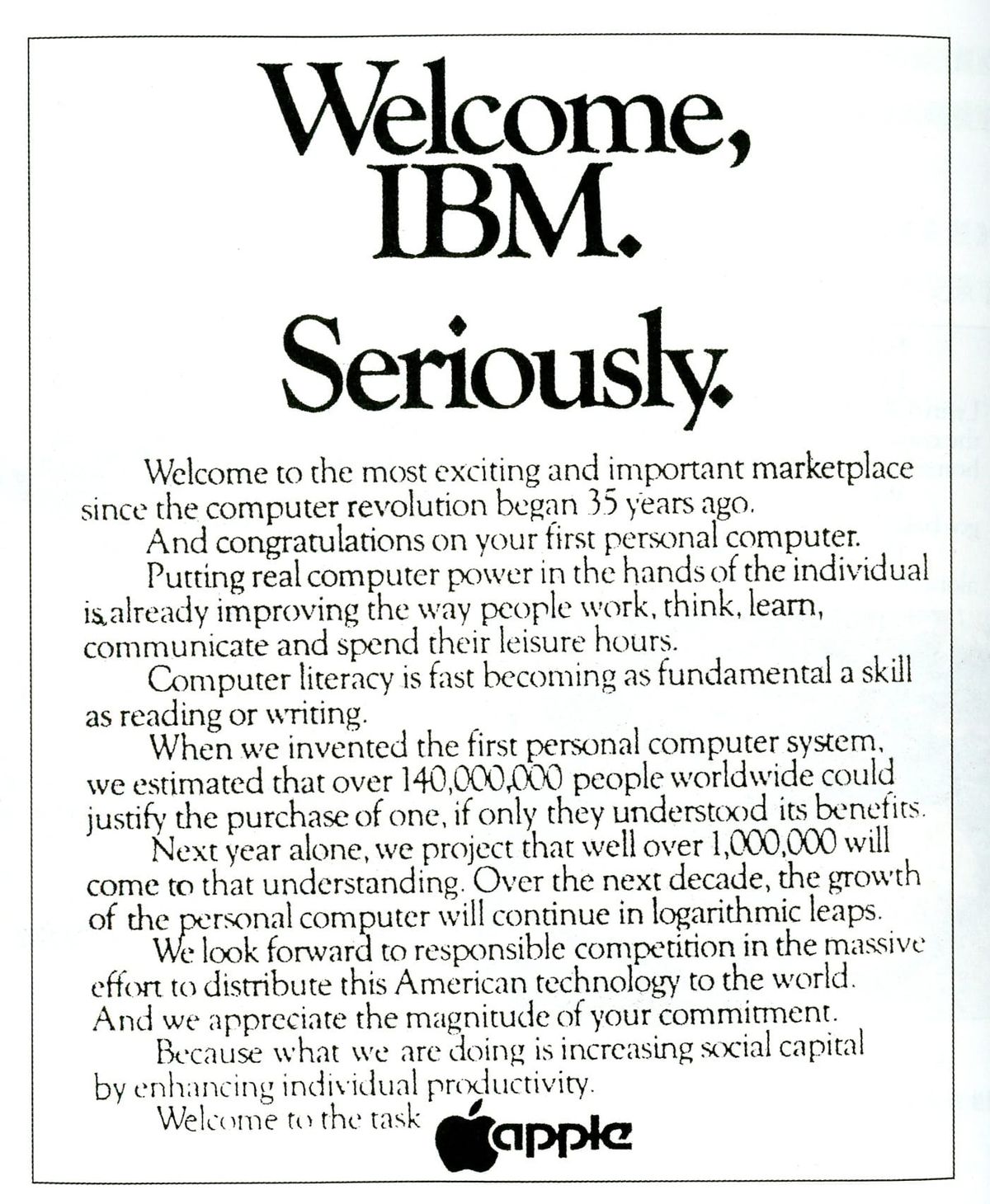
Welcome, IBM. Seriously.
On 12 August 1981, IBM announced the 5150. Apple took out a full page in the Wall Street Journal: Welcome, IBM. Seriously.
It was a genuinely gracious ad, and it was the most expensive piece of copy Apple ever wrote. The Apple II had made the personal computer into a business tool - VisiCalc did that, in 1979, and it is the reason Apple IIs ended up on desks rather than in hobbyist garages. Apple created the category. IBM walked into it eighteen months later with a beige box, an open architecture, and a non-exclusive licence to Microsoft's operating system.
Apple never got that market back. Its successors still eat that lunch, every day, at Apple's expense.
So there is a neat symmetry in saying Apple now gets to be IBM. Another bite at an apple it lost.
Apple needs to be careful what it wishes for, as the rest of that story is not a triumph. IBM's open architecture is what won it the category and what lost it the profits. Compaq reverse-engineered the BIOS inside two years. Clones took the volume. IBM sold the whole division to Lenovo in 2005 and walked away from the market it had defined.
Defining a category and capturing it are two different achievements. IBM only managed the first.
The calculus underneath the calculus
The obvious objection is that Apple doesn't ship volume on thin margins into markets it doesn't own. Never has, never will.
Except that in March, it did exactly that.
The MacBook Neo arrived at $599, and $499 for education, running an A18 Pro. The cheapest Mac ever made, aimed straight at a market Apple had spent a decade conceding to Chromebooks and budget Windows laptops.
It sold out.
That argument is dead. Apple will absolutely build a cheap box in volume for a market it doesn't currently hold, the moment it decides the market is worth holding.
Now look at what happened to it.
The Neo carries 8GB, which was a cost decision taken in a design cycle that closed long before any of this began. Then on 25 June, Apple put the entry price up to $699. Memory. Four months on sale, and the cheapest Mac ever made had lost the only line in its marketing that mattered.
Eight gigabytes was enough to force a seventeen per cent price rise on Apple's volume play.
Now run that same pressure across 256.
This is the shape of the problem, and it is not a strategy problem.
Apple has already proven it will break its pricing discipline for a market it believes in. It has not broken its memory discipline for this one. That isn't a question of capability, or culture, or courage.
It's a judgement. Somebody inside Apple has looked at the business watershed, priced it below iPhones and below cheap laptops, and allocated the memory accordingly.
They might be right. The category is unproven, the buyer is unfamiliar, and the software stack belongs to a Chinese lab that gave it away under an MIT licence.
Being right about the size of a market on the day it opens has never been Apple's forte. Being right about it eighteen months later, that's what's made them one of the biggest companies in history.
The alternative is to wait. Let the business watershed pass, and come in at the home and device watersheds instead, where the volumes are enormous, the margins are familiar, and the buyer is a consumer rather than a purchasing department. Assuming Apple can get the RAM.
There is money there. A great deal of it.
But there is no new market category there. Those are better phones and better Macs sold to people who already buy phones and Macs.
The business watershed is the first genuinely new category in personal computing since the smartphone - nineteen years, and counting.
And that's the difficult calculus. It really does come down to how to allocate limited memory.
Get that wrong in one direction and you leave some margin on the table for a year.
Get it wrong in the other and you spend the next forty-five years watching somebody else own the market you could have had.
Welcome, NVIDIA. Seriously.