
Four Watersheds
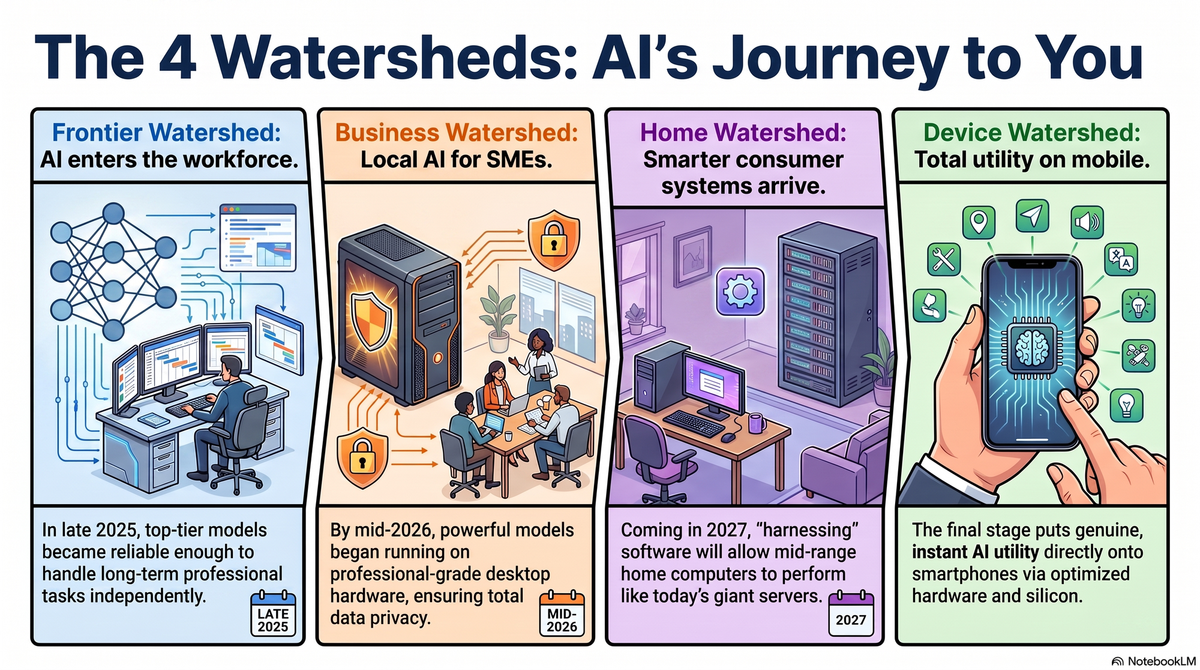
The Watershed - the moment cognitive work collapsed to near-zero marginal cost - looked like a one-off event. In reality, it unfolds as a series; the Watershed isn't a singular event, it's the same event happening four times, at four different scales and price points.
Each time it happens, a different economy gets rebuilt.
Here's where I think we are.
The Frontier Watershed - November 2025
Claude Opus 4.5 was the first model 'good enough' to be left alone with a long-horizon task and a reasonable chance of finishing it. Gemini 3 Pro and GPT-5.2 landed within weeks either side, which is how you know it was a threshold: three labs, independently, crossed the same line at the same time.
This is the first watershed because it transformed the economic landscape of cognitive labour.
It also did something less obvious: it established a benchmark. Once you've seen what 'good enough for real work' looks like, you can measure everything else against it. Opus 4.6, which shipped in February 2026, is the yardstick I'll use for the rest of this piece - the current expression of the bar rather than the moment it was first cleared.
Three more watersheds follow. One for business. One for the home. One for the device in your pocket.
They're all the same crossing. What changes is what it costs to stand on the far bank.
The Business Watershed - 31 July 2026
DeepSeek V4 Flash 0731 is the type site.
It is both 'good enough' - roughly the equivalent of Opus 4.6 on the work most businesses actually need - and capable of running on prosumer hardware, kit broadly affordable by an SME. 284 billion parameters, 13 billion active, MIT licence, a million tokens of context, weights on Hugging Face for anyone who wants to download them.
Unsloth's lossless conversion runs to 162GB. The million-token context window - the same as a frontier offering - adds nearly 10GB, because DeepSeek's researchers developed a new technique consuming roughly two per cent of what an ordinary model might need. Only a year ago that context window alone would have wanted 480GB, putting it well out of reach of small business.
Around 175GB to run one agent. You want 256GB because each additional agent brings its own cache, and running a swarm of them is the entire reason a business wants this on the premises, for every person in the organisation who needs this capability.
RAM is the problem.
DDR5 spot prices have roughly quadrupled since September 2025. Wholesale DRAM prices rose 171% year-on-year. Samsung's 32GB DDR5 modules went from $149 to $239 in a single step, and supply partners are telling customers to plan for another 10 to 20% per month through the end of the year. Memory makers have shifted their lines to HBM (high-bandwidth memory) for AI accelerators, because that is where the margin is, and everyone else is queuing behind it.
The machine you'd want for the business watershed has become the machine you can't buy. Apple didn't stop making the Mac Studio, but it did something almost as telling: it withdrew the configurations. The 512GB option went in March. By May the 256GB M3 Ultra was gone too. The Mac Studio now tops out at 96GB, five times lower than it managed a year ago, and the machines that remain ship in nine to ten weeks.
Apple has quietly retreated from precisely the product that would have owned this moment.
Call it USD $10,000 to run this properly on a desktop today, and you're buying second-hand, or building it yourself, or waiting.
That price point: that's where the IBM PC was at introduction, 45 years ago. A business configuration in 1981 ran USD $3,000 to $4,500. In today's dollars: roughly $10,900 to $16,300.
Personal computing then. Personal AI now.
This setup delivers must-haves you'll never get at the frontier: everything running on your own hardware, so your client files never leave the building, your expertise never trains someone else's model, and your capability doesn't evaporate when a vendor changes its terms or a sovereign nation changes its mind.
It took less than a week for that model to climb to the top of the Hugging Face download charts. Business has worked out the value of 'good enough' AI.
The Home Watershed - early 2027?
This one arrives when an Opus 4.6-class capability fits on a $3,000 computer. A Mac with 32GB of RAM, or an AMD unified-memory system with 48GB.
Note that I said capability, not model.
The key factor here is the right combination of model and harness. We now have a growing body of evidence that a great harness makes a model substantially smarter - that the scaffolding around the weights is doing far more of the work than anyone assumed two years ago. We won't need an Opus 4.6-class model running in the home if the harness it runs inside can lift it over the bar.
That changes who can win. If the home watershed required a frontier model on domestic hardware, it would belong to whoever has the best weights. Because it requires a system, it belongs to whoever can design hardware, model and harness together, as one object.
Whoever gets there first unlocks a consumer market for AI at home that nobody has touched yet.
This is Apple's market to lose. Silicon they own, a harness they could build, a privacy story already told and believed, and a distribution channel in every kitchen in the developed world.
It's also the market they are currently walking away from, one memory configuration at a time.
Do they understand the opportunity?
The Device Watershed - late 2027?
Same principle, smaller box, harder problem.
The device watershed won't be an Opus 4.6-class model running on a top-of-the-range smartphone. It will be a model paired with a harness designed hand-in-hand with the silicon, lifting the combination into genuine utility rather than the disappointing on-device assistants we have now.
This one might belong to Google, who have been building toward it deliberately with the Gemma series. But a model alone is nowhere near enough. They will need an exceptional harness and good-enough hardware, which means enough expensive, rationed RAM in a device with a battery and no fan.
Which brings all four watersheds back to the same constraint.
RAMageddon
Every one of these crossings is gated by memory.
The frontier watershed happened in data centres full of HBM. The business watershed needs 256GB on a desk. The home watershed needs 32 to 48GB in a lounge room. The device watershed needs enough in a phone to make the whole thing feel instant.
And the reason the last three are late, expensive, or hypothetical is that the first one is consuming the supply. The data-centre buildout has bid RAM away from everything else. The frontier watershed is actively rationing the three that follow it.
That's not a temporary distortion to wait out. RAM production grows arithmetically while demand for it compounds. New fabrication takes three to four years to reach volume. The shortage is the shape of the market now, not a wrinkle in it.
So the diffusion of AI into businesses, homes and pockets is not being paced by intelligence. The intelligence is done. DeepSeek just proved you can have Opus-class capability under an MIT licence for the price of a used car.
It's being paced by memory.
Which means the interesting question for the next eighteen months isn't which lab ships the best model. It's who can get the RAM.
Wherever the RAM lands, the Watershed comes with it.