
And Then There Were Two
Google invented the Transformer in 2017.
Everyone in the field knows this.
Everyone in the field also knows that - beyond language translation, which suddenly got very, very good - Google did nothing with it.
Not, apparently, for lack of trying. A few people understood. But not enough, and certainly not enough in the right places in a famously bureaucratic, siloed and political organisation, to get it to change direction.
It's the classic innovator's dilemma. The largest advertising firm in human history - they give the search away free because that's a great way to sell ads - cannot move toward the largest transformative opportunity in twenty-first century technology, because that opportunity does not align with the business it already has.
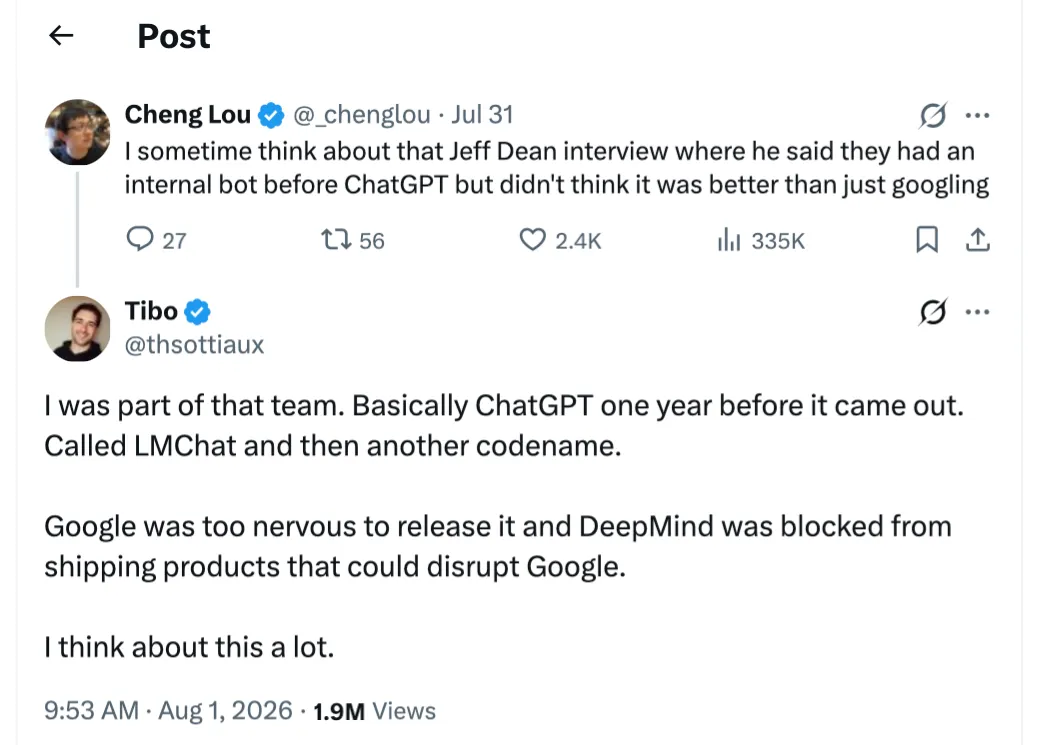
We now know how literal that was. DeepMind had a working chatbot a year before ChatGPT and was not permitted to ship it, for fear of disrupting search.
A year.
Eight authors
Attention Is All You Need carried eight names.
Ashish Vaswani. Noam Shazeer. Niki Parmar. Jakob Uszkoreit. Llion Jones. Aidan Gomez. Łukasz Kaiser. Illia Polosukhin.
Every one of them left.
They went to Cohere, to Character.AI, to Essential AI, to Sakana, to Inceptive, to OpenAI, to NEAR. They founded the companies that ate the lunch of the company that paid for the research.
Google noticed eventually. In 2024 it spent something close to three billion dollars to acquihire Shazeer back.
He left again in June, for OpenAI.
Three billion dollars for roughly two years, and the man who co-wrote the paper is now working for the competition. That's a diagnosis that only looks like a retention problem.
Eppur si muove. The world did not stop just because Google did. OpenAI and Anthropic raced ahead. OpenAI went faster, Anthropic arguably went better. But both went before Google, leaving Google struggling to catch up.
Pyrmont, March 2023
I'm giving a talk about AI to a room of 'commercial' academics - the folks who run the cash-generating foreign arm of a local university. It's my first talk on the topic, because it's all literally so new, for everyone.
I'm delivering it in Google's Pyrmont HQ.
Google got a chance to talk about their own AI work a bit later on.
I have rarely seen a presentation so poorly prepared, so unfocused, so pointless. From the people who had invented this iteration of the field. From the people with enough cash to hoover up every AI PhD on graduation, largely to keep them away from competitors.
That was the first signal that Google didn't really get what was happening, or how to deal with it.
5 August 2026
Come forward three and a half years.
On Wednesday, Alphabet announced a complete overhaul of DeepMind's leadership.
Demis Hassabis steps down as CEO. He becomes Chair of Google DeepMind and Chief Scientist of Alphabet, and keeps running Isomorphic Labs. Kicked upstairs, gracefully, into three titles and no operational control.
Jeff Dean is leaving. Dean co-founded Google Brain, started the TPU programme, and was a Gemini co-lead. He is, by fairly general agreement, the most important engineer Google ever had. He is starting a neolab called Discovery Loop.
He is taking Sanjay Ghemawat with him, after twenty-seven years. And Quoc Le. And Oriol Vinyals, the other Gemini co-lead.
Noam Shazeer had already gone. So had John Jumper, who won a Nobel Prize for AlphaFold - with Demis Hassabis - while working there.
Koray Kavukcuoglu, the last Gemini co-lead standing, takes over and reports directly to Sundar Pichai.
The stock fell four per cent.
These are not the moves of an organisation feeling confident about its next model.
And the models say the same thing. In November 2025 Gemini 3 Pro was arguably the best in the world, good enough to trigger a "code red" at OpenAI. Since then: 3.5 Flash flopped, 3.5 Pro was quietly cancelled, and 3.6 Flash shipped as a bridge to a Gemini 4 that is being hyped rather than demonstrated. Depending on how you count, Gemini is now eighth or ninth. First-party API token growth has decelerated from 60% in the first quarter to 38% in the second.
SemiAnalysis called it: DeepMind is no longer a frontier lab, and its odds of reaching state of the art again "have dropped to zero."
And then there were two.
The part that isn't a failure
Here is where the obvious story stops being the right one.
Google did not fail to monetise the Transformer. Google monetised it perfectly. Just not as a frontier lab.
Google Cloud grew 82% last quarter. Gemini's first-party business is running at roughly $12 billion. By the end of next year GCP is projected to be doing more than $73 billion in third-party AI revenue, plus $120 billion selling TPU systems outright. Two hundred billion dollars of external sales against twelve billion of your own.
More than twenty per cent of TPU production between now and the end of 2027 is going directly to Anthropic.
Read that again. Google is manufacturing the silicon on which its most capable competitor trains the models that beat Gemini, and booking the revenue.
And the neolab playbook now runs like this: leave Google, raise billions from outside investors and from Google Ventures, then spend it on NVIDIA GPUs rented from Google Cloud.
Google has worked out how to monetise its own brain drain.
Thomas Kurian, who runs Cloud, has said the natural thing for a "platform company" to do is sell compute to Anthropic regardless of what it does to Gemini. He appears to have won the internal argument about compute allocation, decisively and permanently.
So the innovator's dilemma resolved, in the end. It just resolved in favour of the landlord.
Be careful what you sell
By the logic of where value actually accumulates, this is defensible. The mint endures. The things the mint produces get spent, inflated and competed away. Infrastructure compounds; models depreciate weekly. If you have to choose between owning the frontier and owning the ground the frontier is built on, the ground is the better asset and it isn't close.
Google has chosen to be the mint.
But there is a price on that ticket that the analysts haven't yet priced.
A landlord never loses. You collect the spread on whoever is winning this quarter, forever, and you never again define what the building is for. For most companies that would be an excellent outcome. For the company that invented the Transformer, wrote AlphaFold, and had a chatbot a year before ChatGPT, it is a demotion with a very good dividend. A landlord never wins.
Google spent nine years failing to turn the most important idea in modern computing into a product.
It has now decided to stop trying, and to sell shovels to the people who did.
Which brings us to the last question, and it is not about America at all.
Two labs is not a market. It's a duopoly with a very short history and enormous capital requirements, and the entire argument for its durability rests on the assumption that the lead is real.
Whatever comes out of China in the next few weeks will tell us whether America's lead was ever in talent.
Or only ever in time.