
'Self-Aware Squares'
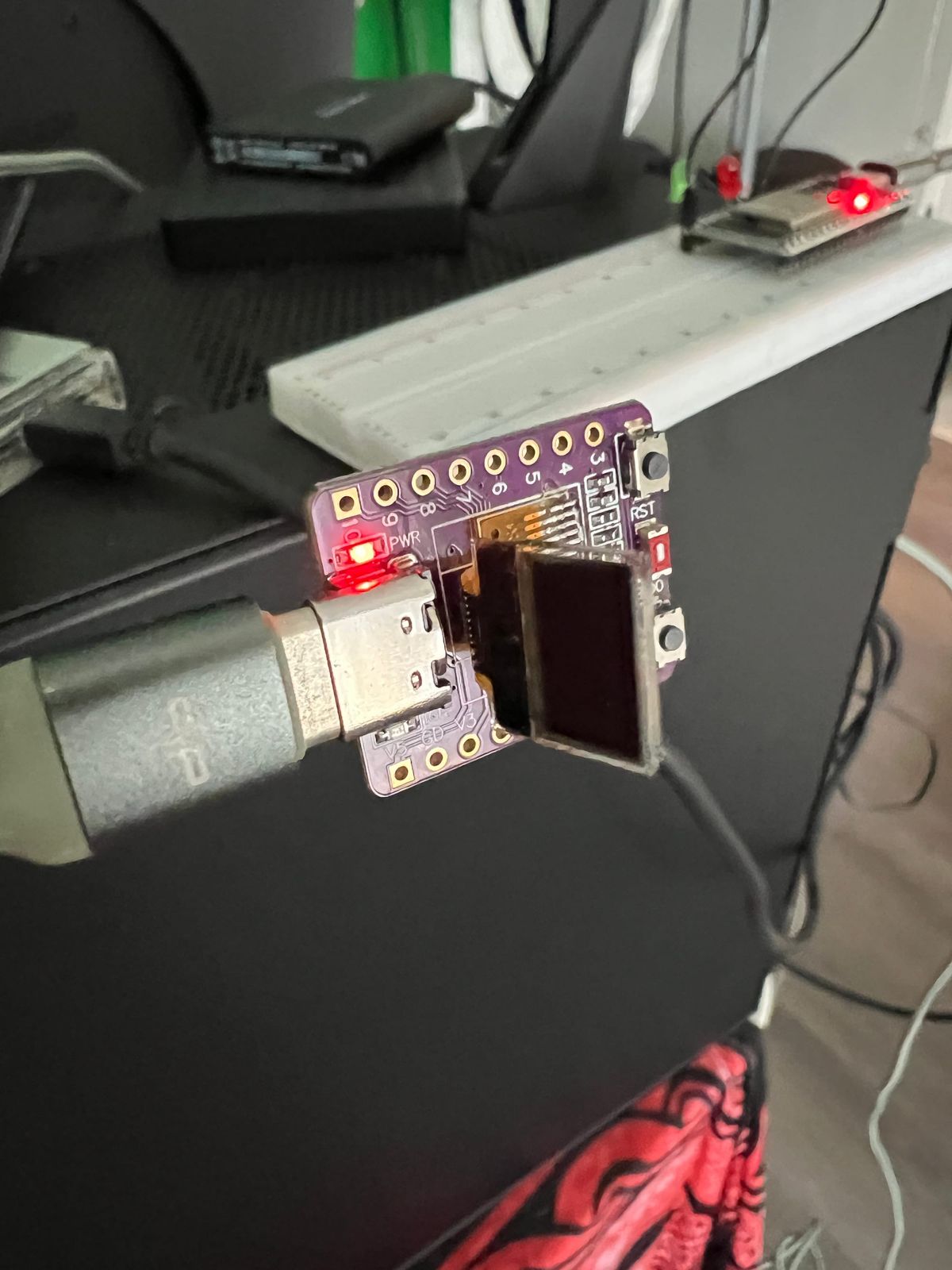
Easter Holidays gave me an opportunity to dive into a project I’d come across a few months before - and it fully demonstrates the unfolding agentification-of-all-the-things…
zclaw puts a powerful agent “harness” on an ESP32. If you haven’t heard of the ESP32,, it's a tiny, cheap and very powerful system-on-a-chip that provides full WiFi and Bluetooth connectivity, paired with a generous amount of memory and a "fast enough" CPU.
Tiny: the photo shows one that's significantly smaller than the USB-C port it's connected to.
Cheap: Less than $1 apiece - and likely a lot less in significant volumes.
Powerful: Capable of running an operating system, even a full-featured 'Micropython' that allows you to program it over Wifi!
Ubiquitous: A fair majority of the 'connected devices' within the home are powered by some version of an ESP32. To quote ChatGPT: "ESP32-family cumulative sales are probably on the order of 1.1 to 1.3 billion units since introduction. My midpoint estimate would be about 1.2 billion ESP32s."
1,200,000,000.
My goal with zclaw was simply to get it running. That wasn't hard (I used Claude to help me with some of the fiddly bits), and by the end of my puttering, I had it installed on the three ESP32s I own. zclaw worked very much the same on each of them - the agents came right up, and I immediately got them communicating over Telegram.
Oh yeah - each of those ESP32s have agents that I can communicate with - in plain English - via Telegram.
What's the value of an agent on such a small piece of hardware? By themselves, my ESP32s don't do much: blink some LEDs, and raise and lower the voltage on some of their pins. It's what those pins can be connected to that makes them so interesting. Every "smart" devices running an ESP32 has control interfaces to those devices - interfaces that could be controlled by an agent running on the device itself.
This means that there a billion or more devices already out there that could 'think for themselves.'
At present, Apple HomeKit and Google Home do the thinking for connected devices. There's no need for that once you put an agent into the device itself.
I caught a glimpse of a future where agency and autonomy would be a feature of devices at postage-stamp scale forty years ago, when I was hanging around with the folks dreaming up a lot of the core ideas in a well-realised nanotechnology. I called those sorts of devices 'self-aware squares': small but smart enough to understand and interact.
That future is here. The capability exists, and will become an increasingly commonplace element in design practice.
As they proliferate, demand for the 'tokens' that power these agents - which all rely on intelligence delivered over the wire - will increase super-exponentially. The coming agentification-of-all-the-things literally means "all the things". Every one of those things will be consuming the tokens it needs to understand us, then acting on that understanding.
The post-Watershed only looks like sitting at a desktop pounding away at Claude Cowork. It's really about every physical element of the environment using intelligence to give itself agency and autonomy.