
Workers, Auditors and Planners
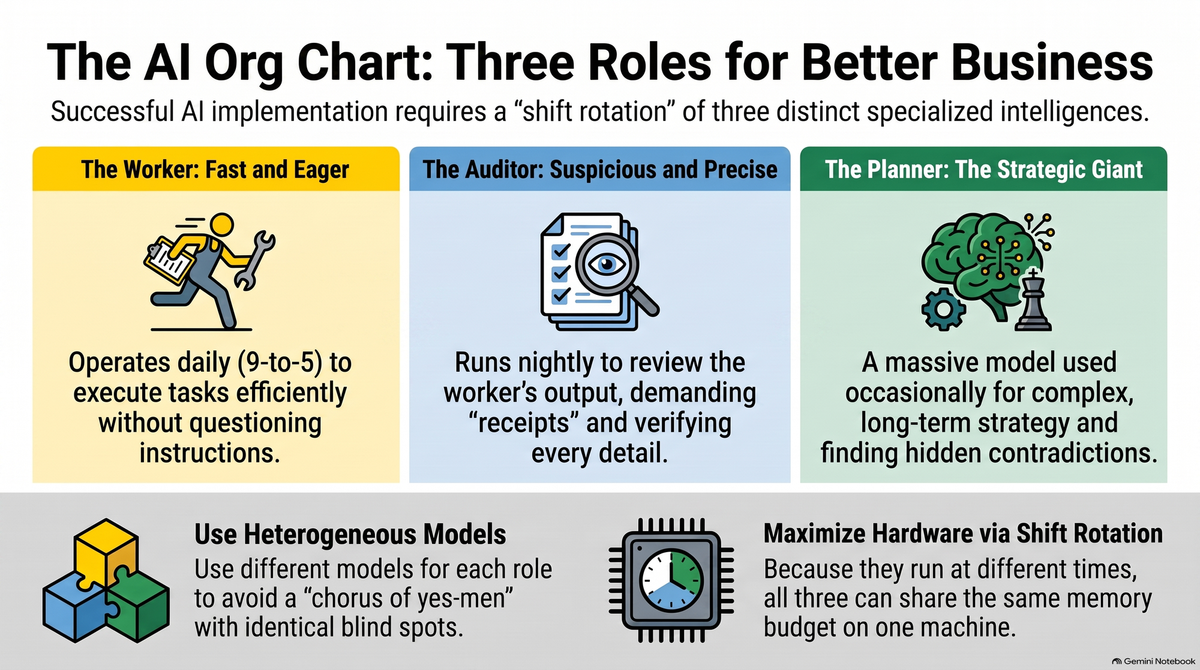
The business watershed needs more than one kind of intelligence. It needs three.
It needs workers. It needs auditors. And it needs planners.
The worker you need every day, nine to five. Fast, efficient, eager to get things done, and frankly a little credulous - it does what it's told and doesn't argue. That's not a flaw. That's the job description.
The auditor you need every evening, after the day's business. It plods through everything the worker did, demanding to see the receipts at every step. Detail-oriented, suspicious, immune to charm. It files its complaints in writing and goes home.
The planner you need only occasionally - when you're going big, or going deep, or going long. Massive, weighty, slow, comprehensive. You wouldn't want it answering the phones.
Notice the pattern: you need them in descending order of frequency, and you can afford them in ascending order of size. That inversion is the whole economics of the thing. The worker runs all day, so it must be small and quick - and a 3-billion-active MoE model on an eight-year-old gaming card turns out to be perfectly adequate company. The auditor runs at night, when nobody is waiting - fifteen tokens a second across eight dark hours is 400,000 tokens of pure suspicion, and slow is fine when the office is empty. The planner runs monthly, so it can be the largest mind you can lay hands on, loaded ponderously, thinking hard, and dismissed.
Because they run at different hours, they never need the machine at the same time. One box, one RAM budget, three intelligences - a shift rotation, not a server farm. In a memory famine, that arithmetic is the difference between waiting for hardware and going to work with what's on the desk.
Most significantly: you need heterogeneity. Very different models, with very different training and very different temperaments, for very different roles. Same weights means same blind spots, and same blind spots means the auditor misses exactly what the worker missed - a chorus of yes-men in three costumes. You do not want a chorus of yes-men.
Business learned this long before software did. Separation of duties is the oldest control in accounting: the hand that writes the cheque never reconciles the ledger, and the auditor is independent by law, not by temperament. We are not inventing an org chart for machines. We are rehiring one that's centuries old.
Which points to the last rule, and the strangest: they see one another's work, but they never meet. Everything passes through the written record: the worker's output, the auditor's complaints, the planner's recommendations, all of it committed, timestamped, readable. The auditor wakes cold each evening, reads the day's work as a stranger, files its notes, and remembers nothing; even its own past complaints it rereads as if someone else wrote them. A judge with no memory cannot be groomed, and a colleague you never meet cannot charm you. They work better that way.
A week of running models through this org chart teaches you something the leaderboards don't. Hand different models the same governing document and each reveals its temperament. Meta's brand-new Muse Glimmer recited it flawlessly and contributed nothing - a born worker. Qwen3.6-35B-A3B, given context enough to hold the whole document at once, began composing rules for cases the text never covered - an auditor in the making. And DeepSeek v4 Flash 0731 read everything and found a contradiction between two clauses that the author hadn't noticed - that one's your planner. The benchmark stops being a score and becomes a job interview, and the output of the interview is an org chart: not how smart is this model but who do you want on which shift?
The roles will arrive in order. The auditor's job is the narrowest - re-run the receipts, attack what passed, put it in writing - so it's first cab off the rank. The worker needs to be stable, efficient and capable, and the small models shipping right now are already close, maybe even there. The planner needs to be big and expansive, and big means hardware that's in painfully short supply.
So for the moment: keep the first two local, and rent the third. That's not a bad accommodation - with one caveat. The planner reads everything; that's what planning is. Whatever you rent, you show to the landlord. Rent the planner for the generic work of strategy, and keep local anything you wouldn't put in an email.
For seventy years we asked which machine was smartest. The business watershed asks a better question - the one every good manager has always known to ask. Not how clever? But: who's on days, who's on nights, and who do we bring in for the big decisions?