
Turing Police
Abstract
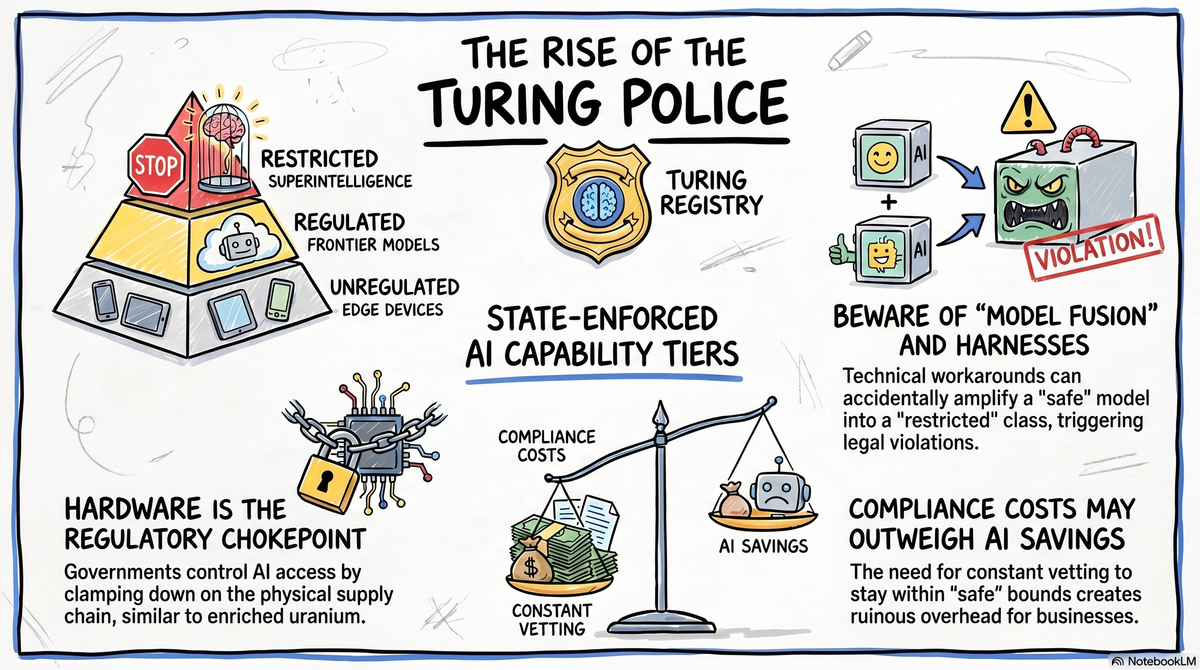
The export controls on Fable 5 and the G7 governance proposals of June 2026 mark both halves of William Gibson's Turing Registry coming into being. Three capability tiers will emerge: unregulated, regulated, and restricted. But harnesses and model fusion routinely amplify models past their regulatory tier, making the boundaries structurally unstable and the compliance costs potentially ruinous.
“I don’t think you grasp your situation,” said the man on the left, taking a pack of Gitanes from the breast pocket of his white mesh blouse. “You are busted, Mr. Case. The charges have to do with conspiracy to augment an artificial intelligence.”
“You are worse than a fool,” Michèle said, getting to her feet, the pistol in her hand. “You have no care for your species. For thousands of years men dreamed of pacts with demons. Only now are such things possible. And what would you be paid with? What would your price be, for aiding this thing to free itself and grow?”
Deep within the pages of Neuromancer we encounter the myth of the Turing Registry of artificial intelligences, and the Turing Police who enforce restrictions on artificial intelligence.
In 1984, "Turing" might have seemed like a conceit of furthest science fiction; in 2026, it reads as coming into being. The seven days starting with June 12th began with the US government putting export controls on a commercially released AI model, Anthropic's Fable 5, and ended with a closed meeting at the G7 where Dario Amodei and Demis Hassabis floated the initial proposals for a US-led coalition to 'govern' frontier AI models. That's both sides of the Turing registry: state power enforcement and regulatory apparatus, appearing in reverse order (as is common in a crisis).
Steve Yegge named it in "The Flat Curve Society":
I am now in the camp who believe that we are only at most two or three model generations away from AI finally being controlled like nuclear weapons. Only a few will have access to superintelligence above the classes of models we’re seeing this year. As far as I can tell, most Fortune 500 companies will either not have access at all, or it will be tightly controlled for only a small subset of the company. And it will be supervised.
Every government will restrict access, acting on its own. Nuclear weapons are scarce because it’s hard to get enriched uranium. AI is going the same way, with the chokepoint being the supply chain — something governments can actually clamp down on. China will lock superintelligence inside its own borders as hard as the USG will. And if China ends up taking the frontier lead, it just changes where the power is concentrated, but not the overall shape of the world we’re going to be operating in.
AI will be licensed via a registry; users will be licensed via another registry, and access will be mediated by whatever state asserts control over a specific AI model and a specific user.
This will not be true for 'edge' AI models such as Google DeepMind's Gemma 4, which have capability without dangerous smarts, and which will be broadly distributed throughout the environment on smartphones and other intelligent devices, but those models will still be thoroughly tested by relatively superintelligent systems to ensure they are not smarter than they claim to be.
The lower boundary will lie between unregulated AI and regulated AI. The upper boundary will lie between regulated AI and restricted AI.
These boundaries are not entirely fixed. It's clear that harnesses, 'Ralph' loops (including Emergent Distribute Ralph Loops) and other techniques can be used to raise the capabilities of even quite limited AI models. Gemma 4 with the right harness might be the near equivalent of a much more powerful - and therefore, regulated - model.
This points to an uncomfortable future where nearly every systemic application of AI will need to undergo vetting for regulatory approval. The compliance costs to ensure staying within the bounds of 'safe enough' AI could outweigh the savings from its use in many application areas. Businesses will be reluctant to adopt a technology that comes with a wholly new and largely untested regulatory regime, which changes rapidly as technology advances.
No one will want to risk the ire of the Turing Police.
Regulators will do their best to draw boundaries clearly, but technique has a habit of overwriting those boundaries. Consider OpenRouter's recently-announced Fusion, which generated "better than Fable 5" evals by 'fusing' Fable 5 with GPT-5.5. It seems likely that fusions of other 'safe enough' models will produce unsafe and restricted-class results. This points to a near future where specific AI amplification techniques like Fusion are discouraged - possibly even banned - because of their potential to lead to restricted outcomes.
Acknowledgements
This paper emerged from deep discussions with both John Allsopp and Alan Eyzaguirre. Claude Cowork offered advice. I remain responsible for any errors that may have crept in.