
The Day the Spoons Went Away

At the recent Homebrew Agents Club, I had a conversation with a friend deep in a startup.
"We're pay $100 a month for Xero - it's just not doing the job for us, and we're not getting the support we need. So we built our own. It's really good. Keeps an open, inspectable ledger. We have text files now!"
This bloke is bright, but even he would be hard-pressed to wave a magic wand and whip up a clone of a SaaS package more than a decade in the making. If he were working on his own. But he's not. We all have Claude Code now.
Post-Watershed - after the back-to-back releases of Gemini 3 Pro, Opus 4.5 and GPT-5.2 - coding tools became 'good enough' to enable entire applications to be constructed from brief text prompts. There's more nuance to it than that - particularly if that app has lots of specific conditions - but that's the general lay of the land, post-Watershed: prompts become applications with very little beyond time separating the directive from the realised tool.
It took me a lot of time to get my head around this - in many ways I'm still getting my head around this - even though I had successfully built a modern, macOS VRML 1.0 browser, in Swift, a programming language I'd never learned. That took me eight hours with Google Antigravity. Even though I'd built a browser for an obsolete specification of a now-antique 3D format - using nothing more than a copy of the specification as an input - I did not make the leap from the specific to the general.
That waited until a swift Zen-like slap upside my head by John Allsopp.
There's been a few moments in my life when a well-placed phrase separates time into a before and an after. One of those - John Perry Barlow's interview with Jaron Lanier in MONDO 2000 #2 - came when Jaron opined, "VR isn't the television of the future. It's the telephone." Before that VR was just intriguing tech. After that, I quit my job, moved to San Francisco, and founded Ono-Sendai.
Friday morning in early February, on one of our regular walk-and-talks, I whinged to John Allsopp about not having all the tools I wanted to do the things I need to do. He just stopped me right there, and said,
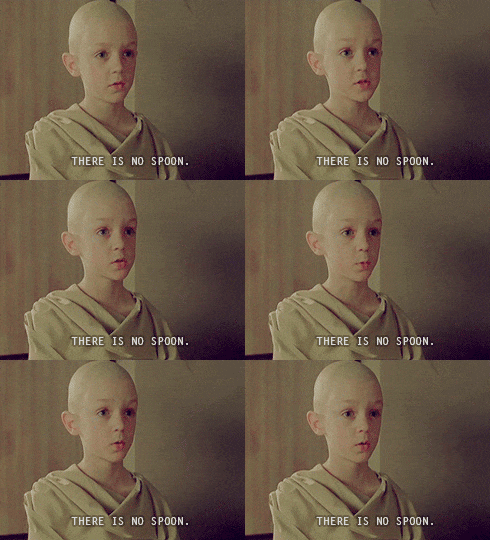
A classic koan. And like all koans, the point is to be with it. So I stood there for a good long minute, watching as all of the spoons in my head simply disappeared. The barriers between conception and implementation vanished. Everything that just a moment ago seemed fixed and immutable melted into air.
Sure, reality will likely never be as perfectly realised as the internal state of mind I entertained in that moment. But reality is convergent with my inner state of complete spoonlessness, that much I could see because it was already obviously happening.
Since then, most of the things that hold my attention fall into one of two categories - determining the 'spoonishness' of something, and determining what remains once all the spoons disappear.
There's layers to both of those, because most of what we think of as organisation in the mid-21st century consists of multiple layers of spoons. This is why people still feel confident that their organisation is special, specific, unique, and can not ever be described as spoons on top of spoons on top of spoons.
Unfortunately, that's simply not the case for most organisations. As spoons disappear - a process, I repeat, already well begun - organisations will "gradually, then suddenly" lose their raison d'être. Many will grasp onto those spoons, imagining them back into existence as quickly as they disappear, becoming so consumed with maintaining the status quo they completely lose their ability to deliver on BAU.
What is a spoon? That depends. Spoonishness, however, is a quality that all spoons share. It's this quality we need to become aware of, to study and understand in all of its manifestations.
Some examples: an e-commerce app is a spoon. A supply chain is a spoon. A product manufacturer is not. Nor is the customer for their products. How the two come together? All spoons. All markets throughout history have always been spoons. That we couldn't do any better meant those spoons assumed a reality they never in fact possessed, and which they are now surrendering.
A pool of capital for claims reserves is not a spoon. Nor is an insurance policy. But an insurance company is a spoon, as are all the law firms and other organisations that intermediate between that pool of capital and the holder of the policy. All of those spoons can be fabricated on demand by some version of Claude Cowork for Law/Insurance/etc.
This might look like radical disintermediation, and it is that, but it's also much more. It doesn't only route around the damage, it erodes the foundations of the systems supporting the damage. Once a spoon is gone, it's not coming back. Not even with all the laws and all the lawyers and all of the policy spoons bending madly. Because spoons have only ever existed in our heads, and once you know "There is no spoon," you can't really go back.
You've been Spoon-pilled.