
Power Point
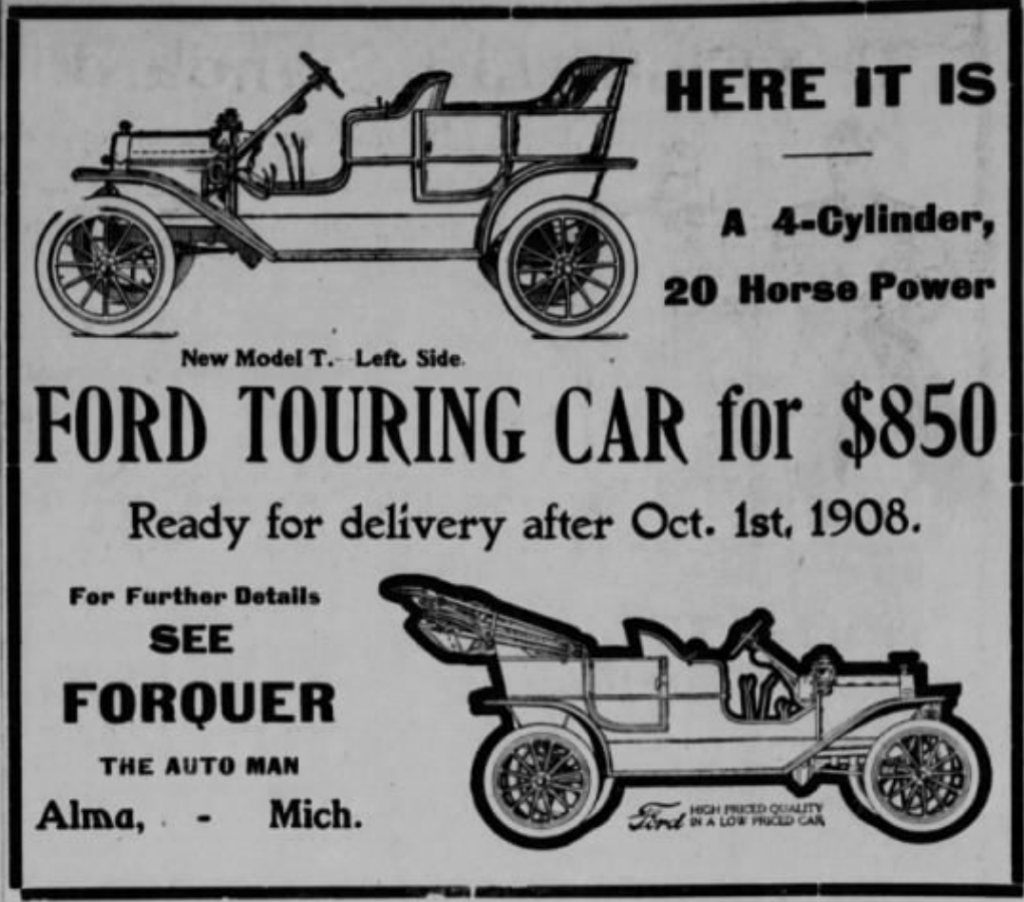
At its introduction in 1909, the basic Ford Model T cost about the equivalent of AU$42,000.
A lot of money.
Then Ford's mass production did its thing; by the early 1920s that same Model T (with all sorts of improvements) cost the equivalent of AU$9,000.
Not cheap, but "affordable enough" that it sold far beyond Ford's initial middle-class market - and in particular, sold to farmers.
In 1920, most rural areas - in Australia and America alike - had not been electrified. Power came from two sources: animals and the environment. Horses and oxen, wind and water.
Almost as if the steam revolution had never happened.
Farm labour was backbreaking toil. It had always been that.
Until the Model T.
In the same way people joke that EVs are batteries with wheels, Ford's Model T was a power plant on wheels.
You could jack up the rear end, throw a belt around one of the wheels, and power a band saw, or a water pump, or a threshing machine, or...
You could power pretty much anything - with some clever attachments. And farmers are very clever. So, it turned out, were their households: among the first things that belt drove was the washing machine. The engine took on the toil of the farm and the toil of the farmhouse in the same season, decades before the wires arrived to do it.
Once Ford realised the market it had tapped, it rushed the Fordson tractor out to meet it. But plenty of farmers wanted the utility of an automobile plus the portable power plant it offered. Well past the end of its production run in 1927, the Model T powered countless farms. Ford kept manufacturing Model T engines until 1941 - when production got diverted entirely to military needs - precisely because it filled such an important need: power, wherever and for as long as needed. And the improvised belt matured into the power take-off, the take-off became a standard, and the standard became an industry. The interface outlived the engine.
Come forward a century. The power plant is a Mac Studio sitting on an office desktop, providing near-frontier AI capability for a whole department. Raw cognition, wherever and for as long as needed. At less than half the introductory price of a Model T.
Just as the farmers applied their ingenuity to that portable power, this generation of office workers will develop their own solutions to their own problems, applying portable cognition.
History never repeats, but it does rhyme. This isn't the age of mechanical power; we've got plenty of that. This is the age of cognition - and we're worried we'll lose our place (per Bill Gates), because something that was until last year sui generis will now be cheap as chips.
We're worried we'll be devalued.
Did the farmers worry about their physical labour being devalued? Or did they look at that 20-horsepower engine and wonder how they might use it next to reduce their toil?
Farming's toil ended and farming as a quarter of the whole labour force ended with it. Children of those farmers found different work entirely, and better. The ones who prospered through the change were the ones who looked at the engine and asked what it made possible.
We're still tightly bound to a scarcity mindset when it comes to cognition, because scarcity is the only world we've ever known.
That world ended at The Watershed. What's left is what the farmers had: an engine, a belt, and the question of where to put it to work.