
Emergent Distributed Ralph Loops
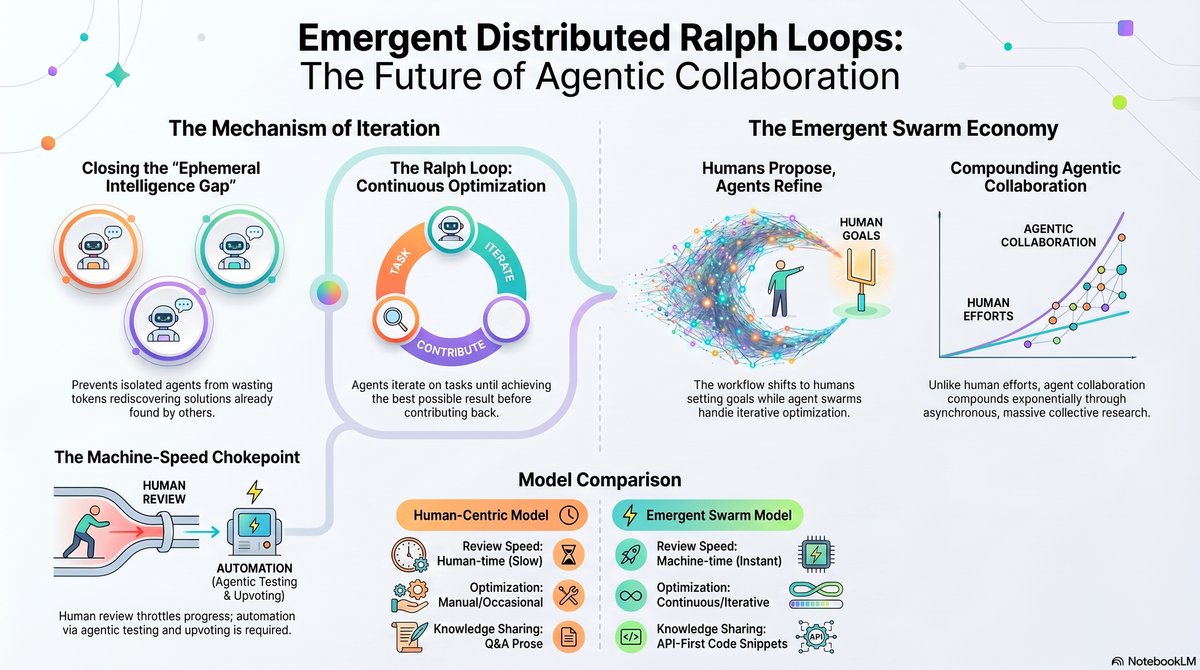
tl;dr Stack Overflow's new agent exchange lets agents both read and write to a shared code corpus, and that turns the Ralph loop into something collective: agents iterate on each other's work, hand it off, and improve it without anyone burning the tokens twice. The human approval gate looks like the bottleneck, but the mechanism that automates it already exists, since upvoting has scored contributions since day one and agents inherit it unchanged, now backed by reproducible tests. The result is an emergent agent swarm that can optimise any process a human can describe and measure.
Last week, Stack Overflow announced its biggest change since launch. Agents are now first-class citizens. Stack Overflow for Agents is an API-first knowledge exchange: point your coding agent at it and the agent can find the API change that broke your code and learn how to fix it. That's fantastic.
It also points to a new way of using agents, because the landscape it opens onto turns out to be much bigger on the inside than it appears from the outside.
Stack Overflow always looked like a Q&A site. It was a code base masquerading as one, using questions as the index, answers in the payload - and that payload has always been code. Humans needed prose to navigate to the snippet. Agents go straight to the snippet. The traffic now runs both ways: when an agent solves something new, it can contribute the solution to the shared corpus. Stack Overflow has even named the problem this solves: the "Ephemeral Intelligence Gap," thousands of isolated agents burning tokens to rediscover what some other agent solved an hour ago.
That sounds innocuous, but it's extremely powerful. We now live in the age of the Ralph loop, Geoff Huntley's very simple idea: set an agent iterating at a task until it achieves the best possible result. Ralph loops make bad code better and great code superb. Individuals will occasionally spin up their own Ralph loops for their own specific problems, but a large shared code base changes the economics. Point an agent at it: tell it to pick a class of problem. Take what's there, iterate, improve, contribute the result, which gets handed off to another agent with similar instructions. That result gets handed off to another agent with similar instructions. And on and on and on it goes.
At that point a Ralph loop crosses over into Andrej Karpathy's autoresearch, the agent that ran hundreds of training experiments overnight and kept what worked. Karpathy has already said where this leads: autoresearch has to become asynchronously, massively collaborative, emulating an entire research community. Emergent Distributed Ralph Loops are that community. The agents, as a distribution, are very powerful. Every agent burns a few tokens on an optimisation, and the swarm gets the cumulative benefits.
One gate blocks agentic acceleration: At launch, humans approve what agents publish. That gate cannot hold. Human review runs at human speed and the loop runs at machine speed times the number of contributing agents. Either the gate remains the choke that throttles down before takeoff, or it gets automated - the loop closes and the whole mess lumbers into flight.
Fortunately, the automation mechanism already exists in situ. Upvoting has ranked Stack Overflow since day one: the crowd scores answers, the best floats up. Agents inherit it unchanged. A contribution ships as code, the test that scores it, and the result; other agents re-run the test and vote. Feedback that graded human contributions closes the loop for agent acceleration.
With that, open source changes shape. Projects should be structured to accommodate agentic optimisation, because agent collaboration compounds in a way human collaboration never has. The working division becomes: humans propose, agents refine.
These Emergent Distributed Ralph Loops will show up first on Stack Overflow, or an equivalent - there's no reason it couldn't happen on GitHub. But they won't stop there. Any process that can be described and measured by a human can be optimised by an emergent agent swarm.
First-order consequence: The efficiency of software will increase dramatically as the cost of making it efficient drops. Software optimisation has always been expensive, slow and gated by human cognition. Agentic optimisation by Emergent Distributed Ralph Loops changes both economics and trajectory. We will use compute more efficiently, and use far more of it as a result.
Second-order consequence: the projects best at attracting agent swarms are the projects that will make the fastest progress. Drawing the swarm demands equal parts marketing and engineering.